
Contents
- Turns Out, My American Normal Wasn’t All That Normal
- 1. Refrigerating Eggs: Nope, Just You, America
- 2. Air Conditioning as a Human Right? Not So Fast
- 3. Cold Drinks = Bad for Your Health
- 4. Cheese That Isn’t Bright Orange? Apparently Normal
- 5. No One Else Uses Red Solo Cups… Literally No One
- 6. Personal Space Is a Privilege, Not a Standard
- 7. Your Accent Isn’t ‘Neutral’… It’s American
- 8. Flushing Toilet Paper Is a Global Hot Debate
- 9. Dryers Are Optional. Crunchy Towels Are Global.
- 10. Cell Phone Plans That Don’t Feel Like Signing a Mortgage
- What You Think Is Normal Probably Isn’t
Turns Out, My American Normal Wasn’t All That Normal
Turns Out the World Doesn’t Want Ice, Use Dryers, or Know What a Red Solo Cup Is
I’d already lived in Ukraine long enough to stop flinching at mayonnaise on pizza.
I’d survived a month-long CELTA course in Poland, where the real test wasn’t grammar… it was staying alive on pierogi and professionally worded rejection emails.
But the real shock didn’t hit me until I started bouncing between countries like Georgia, Albania, Spain.
Each stop chipped away at everything I thought was “just how the world works.”
In the U.S., I grew up thinking air conditioning was a basic human right.
Ice in drinks? Mandatory.
Public restrooms without paper towels? Grounds for a Geneva Convention violation.
Then I got “educated.”
Slowly and quietly.
Sometimes over coffee.
Sometimes while hovering over a squat toilet that didn’t flush paper…
This isn’t about bashing America.
It’s about realizing that a lot of what I thought was standard issue… isn’t.
If you think red Solo cups, AC, and fluffy towels are global defaults, think again.
You’re about to get schooled on just how weirdly American your normal reality is.
1. Refrigerating Eggs: Nope, Just You, America
In France, I once tried to sneak a carton of eggs into the fridge like it was a controlled substance.
My host caught me mid-shelf and stared as if I were about to microwave a baguette.
“Why are you refrigerating those?” She asked.
“Because… salmonella?” I offered, with the kind of confidence only an American public service announcement can instill.
She laughed. “They’re not dead. They’re just eggs.”
Here’s the thing: in the U.S., eggs are washed and sanitized right after they’re laid.
This strips off the cuticle, which is a natural protective coating that keeps bacteria like salmonella from sneaking in.
Once that layer’s gone, the fridge becomes your only defense.
In most of the rest of the world, France included, they don’t mess with that cuticle.
The eggs stay unwashed, protected, and perfectly happy sitting on a shelf like nature intended.
Schooled: It’s not that one way is better. It’s that your “normal” is often just a local workaround for a local system.
But sometimes, the only thing that needs refrigerating is your ego.
2. Air Conditioning as a Human Right? Not So Fast
Try finding a decent blast of AC in a summer apartment rental in France.
Or better yet, take a train across Romania in August.
If you’re lucky, you’ll get a fan that rattles louder than a Lada on cobblestones.
Back home, we treat AC like a basic survival tool.
Elsewhere, it’s something you turn on only if your guests start melting into the furniture.
Schooled: Sweating in silence is global etiquette.
Complaining about it?
That’s all you.
Or just get a fan!
3. Cold Drinks = Bad for Your Health
In Thailand, I ordered an iced water and got handed a look that said, “Are you trying to get sick?”
Locals around me were sipping warm tea like it was a built-in air conditioner for the soul.
In traditional Thai culture, and across much of Asia, cold drinks are thought to upset your internal balance and digestion.
Warm liquids, especially with meals, are the go-to for staying healthy.
Back in Ukraine, I once put a few beers in the fridge during a freezing cold February day.
A friend of mine raised an eyebrow and said, half-jokingly, “You trying to freeze your kidneys?”
In much of Eastern Europe, especially among older generations, cold exposure is believed to cause illness.
Sitting on cold surfaces, walking barefoot, or drinking cold beverages is seen as risky behavior.
Cold beer is common, sure, but drinking it on a chilly day can still trigger worried looks and unsolicited health advice, especially from a babushka.
Schooled: In many places, cold drinks are seen as a direct hit to your internal organs.
Want to blend in and avoid alarming your host?
Sip warm, especially around older folks.
Just know the younger crowd might side-eye you for it nowadays.
4. Cheese That Isn’t Bright Orange? Apparently Normal
I once tried to describe American cheese to a Romanian friend. I said, “It’s bright orange, comes wrapped in plastic, and melts into this gooey slice of heaven.”
He looked horrified and said, “That’s not cheese. That’s edible nuclear waste.”
In France, the cheese section is basically an altar, and none of it glows in the dark.
Schooled: Real cheese smells stronger, tastes better, and doesn’t double as insulation.
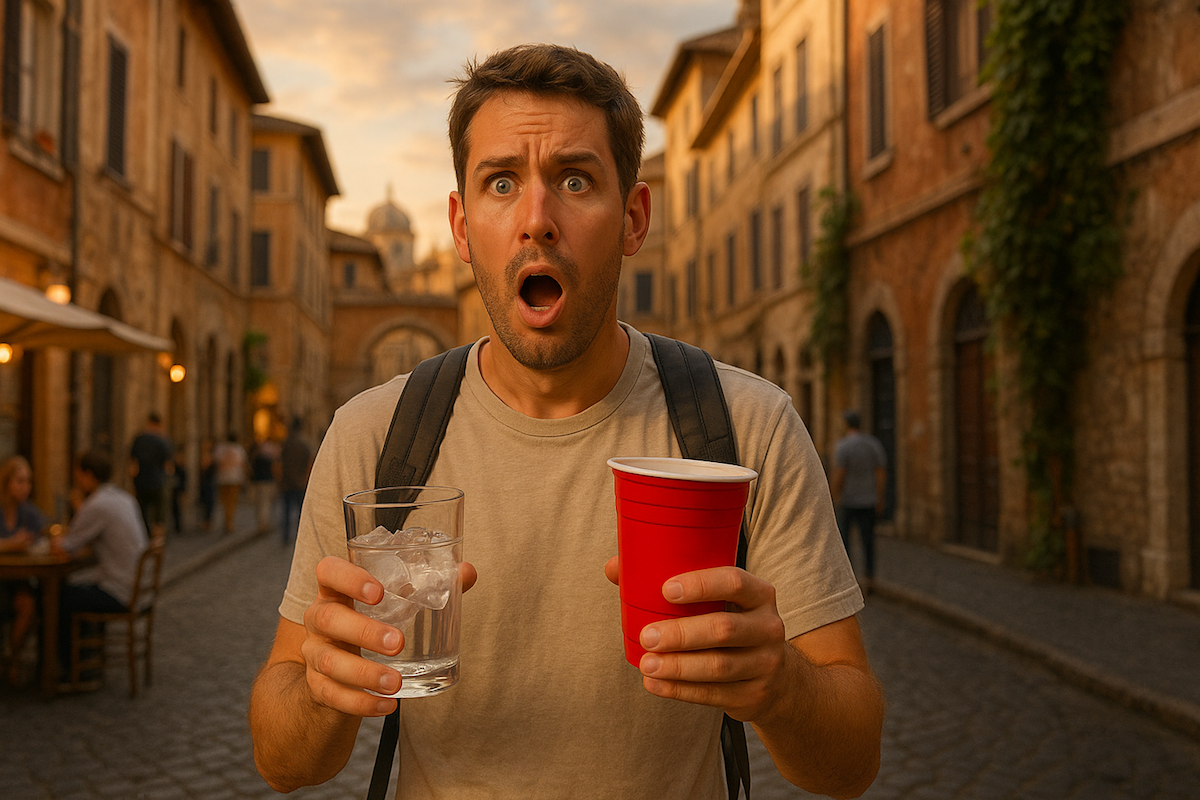
5. No One Else Uses Red Solo Cups… Literally No One
Ask someone in Hungary or Ireland to hand you a red Solo cup and you’ll get either a blank stare or a very poor translation.
During my month-long CELTA course in Krakow, my roommate and I decided to host a small party for our course mates.
I wanted to go full “American-style,” which, of course, meant beer pong.
I spent half the day wandering around Krakow trying to find red Solo cups like I was hunting for some mythical artifact.
Every store clerk looked at me like I’d asked for radioactive Tupperware.
We ended up playing with mismatched plastic tumblers and shot glasses.
No one knew the rules anyway.
Schooled: Red Solo cups are American pop culture, not a global staple.
Abroad, they’re basically unicorns.
6. Personal Space Is a Privilege, Not a Standard
Riding the Kyiv metro during rush hour taught me that armpit proximity is just part of the deal.
In Italy, I dined elbow-to-elbow with strangers like we were all in on a secret.
In North America, we like a good five-foot buffer zone.
Abroad, if you can breathe, you’ve got room.
Schooled: Closeness isn’t an invasion.
It’s just the default setting.
7. Your Accent Isn’t ‘Neutral’… It’s American
I used to think my accent was “standard.” Then I opened my mouth in a café in Spain and the server smiled and said, “Ah, California.”
I’ve been pegged as Canadian, Australian, and once, inexplicably, South African.
But never “neutral.”
Schooled: Everyone’s accent is exotic somewhere.
And yes, yours too.
8. Flushing Toilet Paper Is a Global Hot Debate
In Greece, I stayed at a guesthouse where the bathroom had a sign that said, “Please don’t flush paper.”
In Albania, I learned quickly that the bin is your friend, not a backup plan.
Schooled: Your plumbing habits might just cause an international incident.
Read the bathroom signs. Always.
9. Dryers Are Optional. Crunchy Towels Are Global.
If you’ve ever air-dried clothes in Spain during spring, you know the joy of slipping into what feels like a cardboard bathrobe.
In Ukraine, I learned that towel softness is a trade-off you make when you don’t own a dryer.
No one seems to mind either.
Schooled: That fluffy towel back home? It’s not the global default.
It’s a Marriott perk.
10. Cell Phone Plans That Don’t Feel Like Signing a Mortgage
In Greece, I landed at the Athens airport, bleary-eyed and phone-less, expecting a bureaucratic nightmare.
Instead, I walked up to a kiosk, handed over my passport and 35 bucks, and walked away ten minutes later with a local number, a few gigs of data, and absolutely no contract.
No hidden fees, no 18-month lock-in, no sales pitch for a family plan I didn’t ask for.
Same thing in Georgia.
I was up and running in under ten minutes, sipping a coffee while the SIM activated.
Topping up was as easy as walking into a corner shop or one of the pay box terminals scattered everywhere, handing over a few lari, and saying, “Internet, please.” No paperwork.
No sales pitches and no hassles.
No three-hour call with a customer service rep named Kyle trying to upsell me on an unlimited plan that somehow still caps my usage.
Meanwhile, in the U.S., trying to get cell-phone service without a contract feels like applying for a mortgage and just as expensive.
“Do you have proof of address, a Social Security number, three credit cards, and a utility bill from 1997?”
Schooled: In much of the world, prepaid phone plans are the norm, not some budget-friendly backup.
You pay for what you need, top up when you want, and skip the part where you accidentally sign away your privacy for two years just to check your email.
What You Think Is Normal Probably Isn’t
The more I traveled, the more I realized my definition of “normal” was just a well-rehearsed script written in one country.
That doesn’t make it wrong. It just makes it limited.
Every strange “Do not flush” sign, unrefrigerated egg carton, and fan humming in place of AC chipped away at the idea that my way was “the way.”
So here’s your moment of truth.
What thing did you assume was universal until the world schooled you and said, “Actually… no”?

David Peluchette is a Premium Ghostwriter/Travel and Tech Enthusiast. When David isn’t writing he enjoys traveling, learning new languages, fitness, hiking and going on long walks (did the 550 mile Camino de Santiago, not once but twice!), cooking, eating, reading and building niche websites with WordPress.