
Contents
- You Were Outed Before the Bread Hit the Table
- 1. Sitting Without Being Seated
- 2. Asking for Tap Water Without Knowing the Rules
- 3. Waiting for the Check to Come Automatically
- 4. Speaking Loudly Like You’re at a Booth in a Diner
- 5. Tipping Like You’re Still in the U.S.
- 6. Treating the Menu Like a Suggestion
- 7. Complaining That the Service Is Too Slow
- How You Act Around Food Says Everything
You Were Outed Before the Bread Hit the Table
It’s Not Your Accent That Outs You. It’s What You Do the Moment You Sit Down
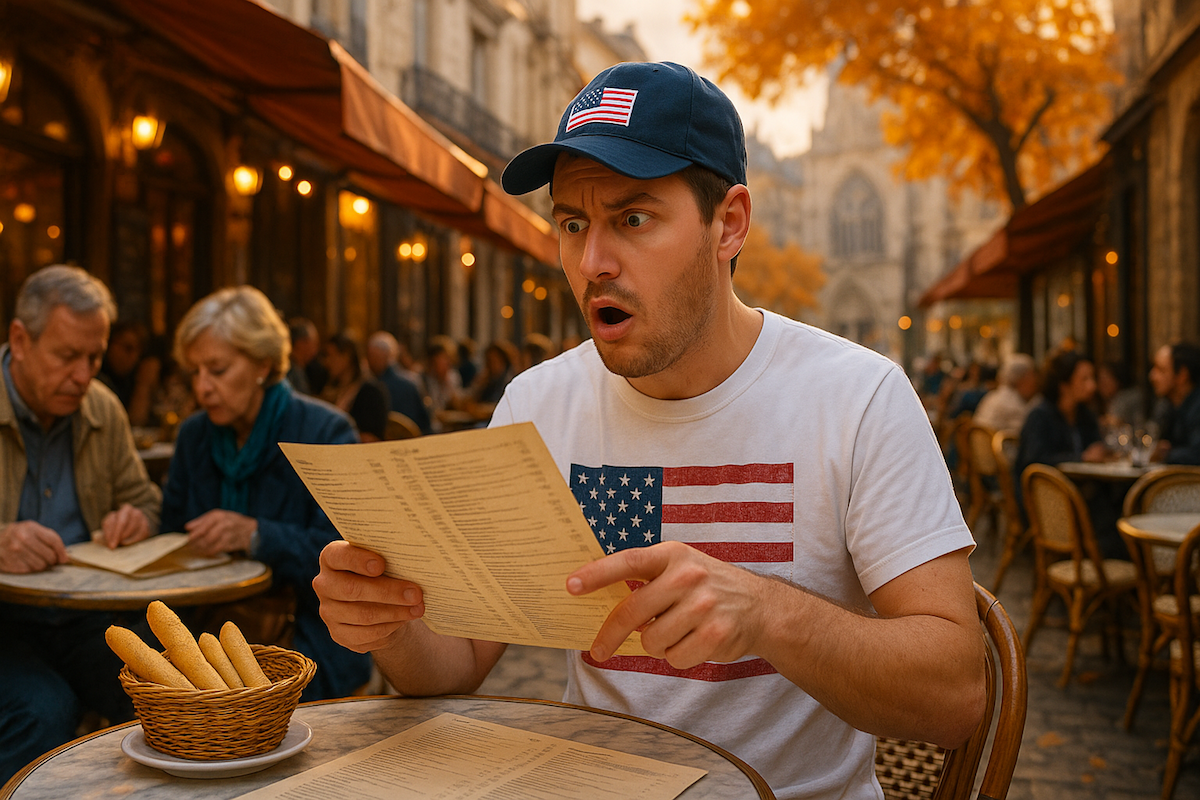
I once watched a guy in a tapas bar in Spain yell “Garçon” across the room to get the waiter’s attention.
We weren’t in France, and even if we were, that’s still not how it works.
The server gave him the kind of slow, blank stare that could only mean tourist alert.
The funny part? He was American.
The funnier part? So was I.
I had made the exact same mistake in Paris on my very first trip.
Only I didn’t yell. I just confidently sat myself down, waved the waiter over, and asked for “a menu.”
He brought me a wine list.
That’s when it clicked.
I hadn’t even ordered food yet, and I had already outed myself.
It wasn’t the accent. It wasn’t my shoes. It wasn’t even the way I pronounced croissant like I was trying too hard to impress a French Airbnb host.
It was how I behaved the second I walked in the door.
You don’t need to speak the language to blow your cover.
I’ve done it in Kyiv when I asked for the bill without even looking up. I’ve done it in Tbilisi when I assumed water would be free.
I’ve done it on the Greek island of Corfu. I figured since it’s popular with tourists and has its own international airport, I expected American-style service.
What I got instead was a reminder that lunch there can be a three-hour commitment.
Americans think it’s the way they talk that gives them away.
It’s not.
- It’s the sitting without being seated.
- It’s the overly upbeat tone when placing an order.
- It’s the tipping before the bread even hits the table.
In this article, I’m going to walk you through seven dead-giveaway habits that instantly reveal you as an American the moment you sit down abroad.
If you’ve ever seen your server raise an eyebrow before you even open your mouth, there’s a reason.
Let’s fix that!
1. Sitting Without Being Seated
In Tbilisi, I watched a couple from Texas stroll into a cozy Georgian wine bar, bypass the host stand, and drop into the best seat in the house with the confidence of someone who thought khinkali was just dumplings.
The server didn’t say a word. He just stared. For a long time.
Then walked away.
That’s when I remembered doing the same thing during my first week in Albania.
I assumed it was self-seating because the place was small.
It wasn’t.
I ended up waiting so long for service I nearly aged out of the menu.
If you don’t see a sign that says “Please Seat Yourself,” don’t. Even if it’s a dive bar in Krakow or a tiny taverna in Thessaloniki.
Wait for the nod. It’s the silent passport to getting served.
Dining Dead Giveaway: Being seated is part of the unspoken ritual. Skip it, and you skip the welcome.
2. Asking for Tap Water Without Knowing the Rules
In Spain, I asked for tap water once and got a look like I’d just requested to wash my socks in the sink.
The waiter simply walked away.
When he came back, he handed me a bottled water and charged me three euros for the confusion.
In Athens, I tried again. I used the local word, kept it polite, even smiled. Still no luck. Bottled water again.
This time, I was told, “It’s better for you.”
Dining Dead Giveaway: Tap water is a cultural trust issue. In some places, it’s perfectly safe but still not offered.
In others, it’s avoided by locals and tourists alike.
If you ask, ask gently, ask correctly, and be prepared for a polite no or a puzzled look.
In France for example, you can ask for “une carafe d’eau s’il-vous-plaît.” (“a carafe of water, please.”).
3. Waiting for the Check to Come Automatically
The first time I had lunch in France, I sat for nearly an hour after my espresso, assuming the check was on its way.
The waiter passed by at least five times. He smiled, cleared plates, refilled water, but never brought the bill.
Turns out, I had already broken two rules.
First, I lingered without asking.
Second, I expected American-style efficiency in a place where meals are slow by design.
Dining Dead Giveaway: In Europe, the check only arrives when you ask for it. You’re not being ignored. You’re being respected.
But if you want to leave, you have to signal it.
Otherwise, they assume you’re staying for dessert, conversation, and possibly the rest of the day.
4. Speaking Loudly Like You’re at a Booth in a Diner
I was once in a tiny café in Hungary when a group of Americans walked in.
I knew they were American before they even opened the door. Their voices carried like a high school pep rally.
Locals stopped chewing. One man put down his newspaper.
Even the barista looked up.
I’ve done this myself more times than I’d like to admit.
Especially in countries where people speak softly, like France, Germany or Austria, your normal speaking voice might sound like a public announcement system.
Dining Dead Giveaway: Volume is cultural. Lowering your voice isn’t about hiding. It’s about blending in.
If the room is whisper-quiet and you’re holding court at full blast, you’ve already lost the plot.
5. Tipping Like You’re Still in the U.S.
During my month in Krakow during my CELTA course, I finished a casual lunch at a local café, pulled out some coins, and tipped what I thought was a respectable amount.
The waitress gave me a polite smile, then quietly returned with exact change.
She left it neatly on the tray next to the tip I had just tried to give her.
Message received.
In some countries, tipping feels more like a thank-you than a transaction. In others, it’s already included.
But if you treat it like part of the bill and toss down a percentage as if you’re at an Olive Garden in California, it can feel awkward, even a little off-putting.
In France, where I spent years trying to figure out the unwritten rules of tipping, I learned that being subtle is key.
Round up the bill, leave a small note or a few Euro coins, slip it under the edge of the receipt. No fuss, no muss.
Anything louder than that feels like you’re buying something more than service.
Or trying to act like a Big Shot.
Dining Dead Giveaway: In most places I’ve lived or traveled, tips come at the end, quietly and without show.
Tipping like you’re still stateside won’t win you points. It’ll just make you look like you’re trying too hard.
6. Treating the Menu Like a Suggestion
At a rural, family-run restaurant along the Camino de Santiago, I watched a British pilgrim politely ask the owner for some lemon with his salad. Nothing outrageous.
But it came after he had already asked for no onions, dressing on the side, and a different type of lettuce if possible.
The owner, who was also the chef and clearly took pride in every dish that left her kitchen, froze for a second.
Then she let out a small sigh, turned on her heel, and disappeared into the back without saying a word.
The lemon never came.
Neither did any more modifications.
What had started as a simple request turned into a slow-motion cultural collision.
In some parts of the world, especially in small-town Spain, the menu isn’t a list of options. It’s a declaration of how the food is meant to be experienced.
Dining Dead Giveaway: In many local spots, especially those with a proud cook behind the counter, requests for changes can feel like criticism.
Stick to what’s offered.
If you really need lemon, maybe just quietly hope it’s already on the plate.
7. Complaining That the Service Is Too Slow
In the Greek island of Corfu, I waited almost an hour for my lunch. At first, I was annoyed. Then I looked around.
Locals were on their second glass of wine. The servers weren’t rushing. Nobody cared.
Except me.
Back in Ukraine, I once asked why the server hadn’t come back to check on me. A friend told me, “That’s considered annoying here.”
That’s when I realized something.
What I thought was bad service was just… not American service.
Dining Dead Giveaway: Slowness is not always a problem. In many cultures, eating is an experience, not a transaction.
Rushing through it says more about you than the staff.
How You Act Around Food Says Everything
You can ditch the fanny pack. You can study the language. You can even nail the dress code.
But the moment you sit down, how you act is what gives you away.
Restaurant etiquette is where Americans often reveal themselves without even realizing it.
The good news? Every one of these habits is fixable.
The better news? Most locals are forgiving. They expect a few fumbles.
What matters is whether you learn from them or keep asking for tap water like it’s a constitutional right.
What about you?
Have you ever made a restaurant faux pas while traveling?
Misery may love company, but travelers love great stories.

David Peluchette is a Premium Ghostwriter/Travel and Tech Enthusiast. When David isn’t writing he enjoys traveling, learning new languages, fitness, hiking and going on long walks (did the 550 mile Camino de Santiago, not once but twice!), cooking, eating, reading and building niche websites with WordPress.