
Contents
- Tipping Like a Big Shot? The American Art of Turning Gratitude Into a Flex
- 1. Tipping Like You’re Still in the U.S.
- 2. Ignoring the Service Charge Already Included
- 3. Leaving Coins Instead of Rounding Up
- 4. Tipping at Fast Food Counters or Street Carts
- 5. Overdoing It in the Balkans
- 6. Expecting Better Service Just Because You Tipped Well
- 7. Not Tipping Where It Is Expected
- What’s the Worst That Could Happen?
Tipping Like a Big Shot? The American Art of Turning Gratitude Into a Flex
How a “Nice Tip” Can Backfire in Europe and What You Should Be Doing Instead
Ever leave a tip in another country and feel like you just handed someone an insult wrapped in local currency?
I have.
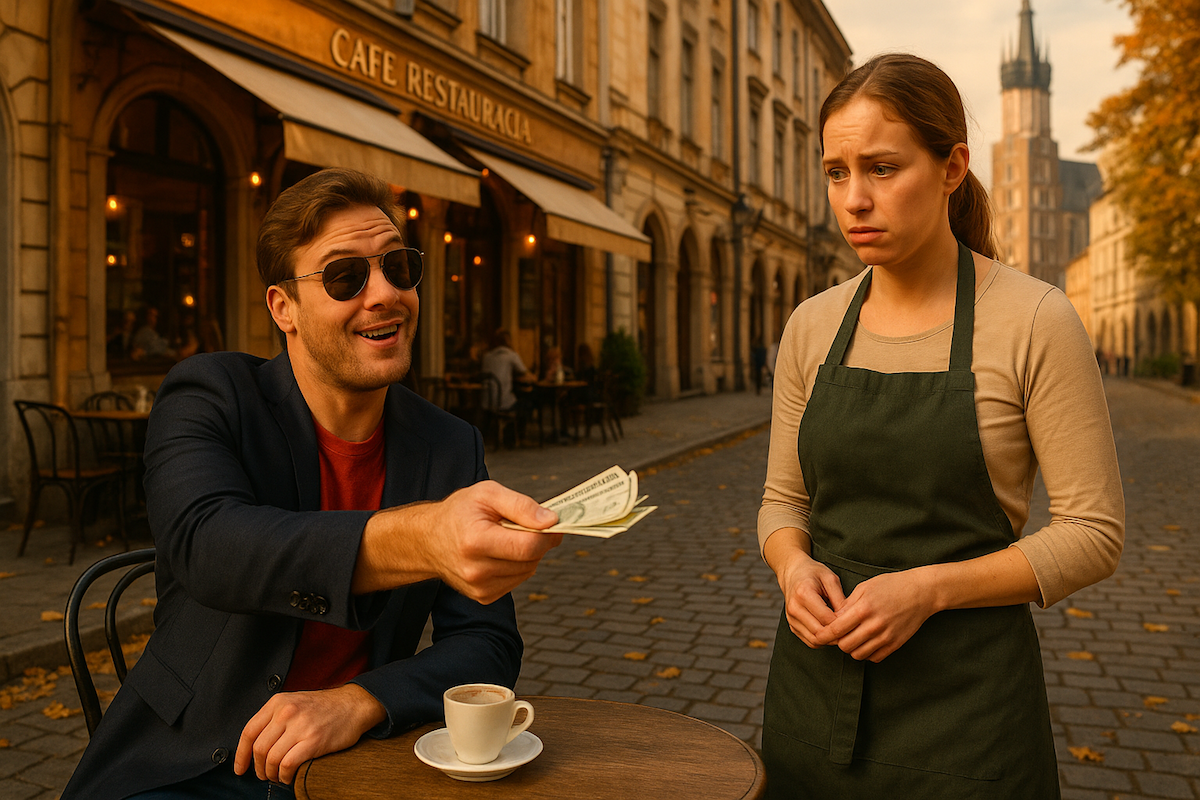
In Krakow, I slid a few notes under the espresso cup and gave the waitress a friendly nod.
She returned moments later with the cash in her hand and a look that said, “Try again, Yankee.” I thought I was being polite.
Turns out, I was the punchline of someone’s lunch break.
Tipping, it turns out, isn’t a universal language. In some places it’s a thank you.
In others, it’s an accusation.
In France, a fellow traveler I met in Strasbourg at a pub left a few coins and got the kind of side-eye usually reserved for loud tourists trying to show off and line-cutters at the bakery.
Even in Italy, where I assumed tipping was welcome, I’ve seen locals just round up the bill and walk out like it was nothing.
Meanwhile, I’m calculating percentages like I’m preparing a tax return, sweating over whether five euros is respectful or offensive.
After years of living in and bouncing between countries like Ukraine, Albania, Georgia, and France, I’ve learned that tipping abroad is less about generosity and more about cultural fluency.
What gets you a thank you in Canada might get you a confused stare in Tbilisi. Or worse, a quiet conversation about “those Americans.”
In this article, I’m going to break down the seven tipping mistakes I’ve seen (and made) across Europe and beyond.
If you’ve ever tipped too much, too little, or just plain wrong, you’re not alone.
Let’s fix that before your next espresso turns into an etiquette disaster.
1. Tipping Like You’re Still in the U.S.
Back in the States, tipping 20 percent is second nature. You don’t even think about it. You just do the math, scribble the total, and feel like a decent human being.
But try that in a Parisian café and you’ll earn confused stares or, worse, subtle mockery from the locals.
In Dieppe, I left a solid 20 percent tip after a great meal at a seafood place.
The waiter literally chased me out the door, thinking I’d forgotten my change. When I explained it was a tip, he blinked and said, “Why?”
That’s when it hit me.
In France, tipping is already included.
Anything extra makes you look like a clueless tourist … or someone trying too hard to impress.
Spare the Change: When in doubt, look at the bill. If service is included, a small round-up is plenty.
You’re not in Kansas anymore Dorothy.
2. Ignoring the Service Charge Already Included
In Italy, my family tree might trace back to tiny villages in Lombardia, but my American habits still gave me away.
I once tipped on top of a “coperto” in Milan like I was securing a dinner invite to Nonna’s house.
The waiter gave me that polite-yet-smirking look that says, “This one just got off the plane.”
The “coperto” is already baked in. It covers the service, the bread, and probably a little side-eye if you tip too much.
Locals rarely leave more than a euro or two.
Spare the Change: Always check for a service fee on the bill.
If it’s there, skip the calculator and just round up modestly.
3. Leaving Coins Instead of Rounding Up
In Ukraine, I made the mistake of leaving a small mountain of coins on the table after a quick lunch.
The waitress looked at it like I’d just dumped out my pocket lint.
In many Eastern European countries, tipping is appreciated, but it has to look intentional, not like you emptied your wallet and called it generosity.
Even in places like Poland, where I took a CELTA course, I saw fellow trainees doing the same thing.
Dropping leftover change like it was spare karma. Locals don’t do this.
They round up neatly or leave a clean note.
No one wants your pocket full of 10 groszy coins.
Spare the Change: Keep it tidy. Round up or use a small note.
If your tip jingles, rethink it.
4. Tipping at Fast Food Counters or Street Carts
In Tbilisi, I once tossed some change into a jar I thought was for tips at a puri (fresh bread) stand. The woman behind the counter looked at me like I’d just offered her a tip for breathing.
I wasn’t trying to be patronizing. I was just hungry and awkward.
But that’s the thing. In many countries, tipping is reserved for sit-down meals with table service.
Street vendors, food stalls, and fast-casual joints don’t expect it. Sometimes they don’t even know what to do with it.
Spare the Change: If there’s no table service, skip the tip. Save it for the espresso you’ll have after.
5. Overdoing It in the Balkans
In Saranda, Albania, where I’ve been living on and off, I once left what I thought was a generous thank-you at a local restaurant.
The waiter looked visibly uncomfortable and tried to give it back. He thought I made a mistake. I hadn’t. I just hadn’t read the room.
The same thing happened to a friend of mine in Timisoara, Romania. He tipped like he was in Manhattan, and the waiter asked if he was trying to buy the restaurant.
Some cultures interpret large tips as either confusion or condescension.
Spare the Change: Keep it low-key. In the Balkans, less is more.
Round up modestly and you’re golden.
6. Expecting Better Service Just Because You Tipped Well
In the U.S., we’ve been trained to tip well if we want great service next time. It’s part of the deal.
But in most of Europe, service isn’t something you buy with a bigger tip.
It’s either good or it isn’t, regardless of what you leave behind.
In Krakow, after leaving what I considered a generous tip on night one, I returned the next day expecting a warm welcome.
The same waitress barely recognized me.
My tip had been filed under “weird foreigner behavior” rather than “VIP customer.”
Spare the Change: Don’t tip for leverage.
Tip because it’s appropriate. Anything else just sets you up for disappointment.
7. Not Tipping Where It Is Expected
While overtipping can be awkward, not tipping at all in some countries can feel like a slap in the face.
A fellow expat I met during my time in Spain told me about his trip to Egypt where he didn’t tip the hotel porter.
Let’s just say that by the time he left, his suitcase had more mysterious stains than it arrived with.
Even in some touristy parts of Mexico or areas in Greece, not tipping your taxi driver or hotel staff might get you a reputation faster than a bad Yelp review.
Spare the Change: Do your homework.
Some places don’t just expect a tip… they depend on it.
Know before you go.
What’s the Worst That Could Happen?
If tipping abroad were just a matter of money, it wouldn’t matter so much. But it’s not. It’s a silent language.
Get it right, and you blend in.
Get it wrong, and you become “that tourist.”
It’s the difference between being seen as a respectful visitor or the reason someone goes home and rants about Americans over dinner.
So the next time you reach for your wallet in a café in Krakow, a puri stand in Tbilisi, or a wine bar in Alsace, take a beat.
Ask yourself, “Is this a thank you, or a social landmine?”
- What’s the most awkward or confusing tipping moment you’ve ever had abroad?
- Did they thank you, refuse it, or just glare until you backed away slowly?

David Peluchette is a Premium Ghostwriter/Travel and Tech Enthusiast. When David isn’t writing he enjoys traveling, learning new languages, fitness, hiking and going on long walks (did the 550 mile Camino de Santiago, not once but twice!), cooking, eating, reading and building niche websites with WordPress.