Contents
- Europeans Call It Trash…. But They Just Can’t Stop Eating It.
- 1. French Kids Are Quietly Cheating on Camembert with Kraft Singles
- 2. Mountain Dew Is Basically Liquid Contraband for German Students
- 3. Spanish Locals Will Trade You Tapas for Doritos
- 4. Dutch Teens Crave the ‘Dirty’ American Version of Oreos
- 5. Pop-Tarts Are the Snack Currency of Eastern Europe
- 6. Italians Will Die on the Hill of Food Purity… Then Hide Marshmallows in Their Pantry
- 7. Spanish Gen Z Has Turned American Junk Into Aesthetic Culture
- Final Bite to Chew On
Europeans Call It Trash…. But They Just Can’t Stop Eating It.
They Mock It in Public, Crave It in Private. Europe’s Dirty Little Junk Food Secret No One Talks About… Except Me.
Have you ever been told your food is basically poison by someone who secretly hoards your snacks?
I have.
After years of living, working, and eating my way through France, Georgia, Poland, Ukraine, and most of Europe, I’ve heard it all.
- American food is toxic.
- American food is fake.
- American food is barely even food.
All of which are usually said with the same tone and disdain someone might use to describe nuclear waste.
Fair enough. We’ve got our issues.
But what never gets mentioned is the late-night love affair happening behind closed pantry doors.
I once knew a French University student confess, in a whisper, that she kept a stash of peanut butter M&M’s hidden behind her organic herbal teas in her dorm.
A Polish classmate from my CELTA course asked me to bring him Cheez-Its, “just once,” the next time I came to Poland, like it was some kind of sodium-laced forbidden fruit.
In a Dublin hostel, a Dutch backpacker told me the European version of Skittles was “too clean” and actually tasted like air freshener.
Turns out, banning American junk food doesn’t kill the appetite.
It just makes it feel like contraband.
This article takes you straight into the snack drawer of European hypocrisy.
We’re talking about the banned American foods that supposedly civilized Europeans can’t stop craving, even if they pretend to be disgusted by them in public.
1. French Kids Are Quietly Cheating on Camembert with Kraft Singles
While living in France, I met a lycée teacher in Strasbourg whose son once traded three slices of local brie for one Kraft single at recess.
His logic? “It melts better on a burger.”
She told me this like she was confessing he’d started vaping.
Their fridge had a shrine to obscure Dijon mustards, yet tucked in the back was a pack of Kraft singles, strictly for burgers, croque monsieurs, or late-night cravings.
I started hearing similar stories.
One friend swore she only bought “le cheddar américain” at Carrefour for the kids, but I watched her melt it over her own omelette.
Lesson worth noting: Even proud cheese cultures crumble when faced with flawless meltability.
2. Mountain Dew Is Basically Liquid Contraband for German Students
While I was teaching in Ukraine, a German colleague told me about a group of students in Cologne obsessed with American Mountain Dew.
Not because it tasted good, but because it was off-limits.
The U.S. version is loaded with stuff banned or restricted in the EU: yellow dye, high-fructose corn syrup, and a splash of brominated vegetable oil for good measure.
So what did these kids do?
They formed a private online group, pooled cash, and shipped in cases from the States.
They even compared batches by state to see which one tasted most toxic.
It wasn’t a drink. It was a ritual.
They poured it into glasses, sniffed it like whiskey, and shared tasting notes like sommeliers of radioactive nectar.
“It’s not the flavor,” my colleague said. “It’s the thrill of drinking something that feels illegal.”
What it tells you: Ban something, and it doesn’t disappear. It becomes sacred.
Or a dare.
3. Spanish Locals Will Trade You Tapas for Doritos
On my second Camino de Santiago, an Irish pilgrim at our albergue silently opened a crushed bag of Cool Ranch Doritos.
He didn’t offer. He didn’t need to.
Within minutes, three Spaniards hovered nearby, including the hospitalero who’d just ranted about “American chemicals.”
When he offered him a handful, the hospitalero hesitated, then grabbed two and muttered something about “exceptions.”
Later in Finisterre, another Spanish pilgrim told me her cousin in the U.S. was required to bring back bags of “ranchitos.”
The EU version, while technically healthier, didn’t hit the same. “They’re not poison if you eat them fast,” she joked.
Bigger truth beneath the crunch: Once your brain locks in a flavor, cleaner versions feel like knockoffs.
4. Dutch Teens Crave the ‘Dirty’ American Version of Oreos
During a bus trip through Greece, I had met a Dutch woman who confessed her love for “the real Oreos.”
Not the sleek, reformulated EU versions that use natural dyes and palm oil alternatives.
She meant the factory-standard American ones with the old-school flavor and that unmistakable greasy crumble.
She told me she grew up eating the EU-safe version but always felt something was missing.
During a trip to New York, she tried the American Oreos and said it was “like meeting the loud cousin of someone you thought you already knew.”
She stocked up before flying home and hid them like contraband.
Clear insight: Familiarity creates loyalty, but forbidden familiarity creates obsession.
5. Pop-Tarts Are the Snack Currency of Eastern Europe
When I lived in Kyiv, I noticed a quiet ritual whenever someone returned from the U.S. or UK.
It wasn’t just the jet lag or overpacked suitcases.
It was the mindful unpacking of American snacks like they were holy relics.
One of my business English students made regular trips home and once asked if I wanted anything.
I requested pancake mix and Vermont maple syrup.
She brought those, but her real treasure was a box of brown sugar cinnamon Pop-Tarts.
Half-crushed. Slightly stale, but an instant legend.
She offered me one during a long break.
Within minutes, two other teachers materialized like they’d caught the scent.
When I worked in Donetsk, it was the same story.
I met a teacher who worked at another school who used Skittles and Jolly Ranchers as prizes once his students got bored of stickers.
I asked if it worked.
“If I bring American candy, they write full paragraphs. If I bring apples, they ask to go home.”
Undeniable reality: You couldn’t pay rent with Pop-Tarts, but you could buy goodwill, attention, and rare peace in a break room.
6. Italians Will Die on the Hill of Food Purity… Then Hide Marshmallows in Their Pantry
One of my former colleagues once told me about her uncle from Rome that made a family dessert each Christmas that no one was allowed to watch him prepare.
The recipe was his “secret,” passed down from no one.
Turns out, his secret was Jet-Puffed marshmallows imported from Boston.
He used them to make a bastardized version of torrone, the traditional nougat, except with gooey texture and American flair.
He stored them in a bin labeled “farina,” convinced that if his wife found them, she’d toss them in the trash.
When I asked why he didn’t just use European marshmallows, she scoffed and said, “Because those are made for adults. The American ones are made for taste.”
What this reveals: Sometimes, purity is a performance, and indulgence happens offstage.
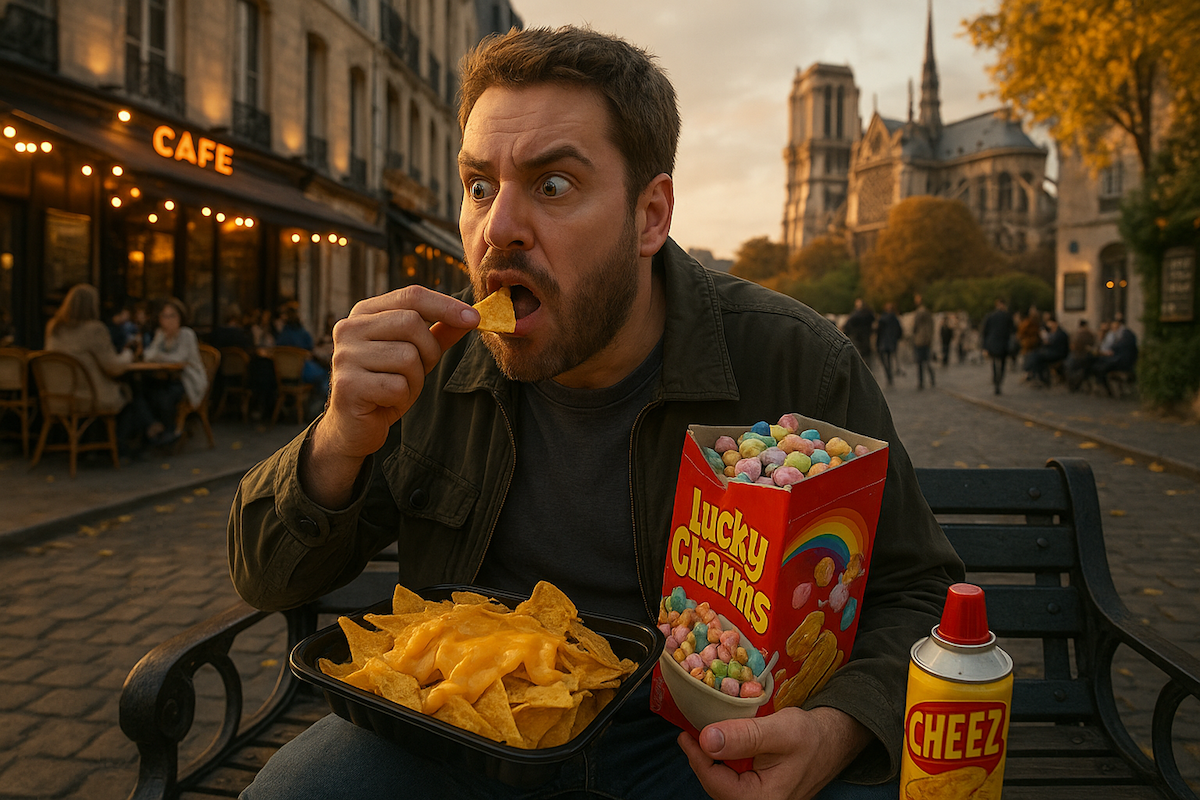
7. Spanish Gen Z Has Turned American Junk Into Aesthetic Culture
Once when a fellow Albanian passenger on the mini-bus ride down to Saranda found out I was American, showed me a TikTok her teenage cousin in Madrid had posted.
It was a slow, dramatic pan across a box of Lucky Charms on a shelf, set to moody music, like it was some kind of sacred artifact.
Apparently, American junk food has become an aesthetic in certain corners of Spanish youth culture.
Kids aren’t buying Cap’n Crunch or Cookie Crisp to eat them.
They’re styling them.
Fruit Loops get more camera time than most influencers’ faces.
Her cousin and her friends even had a name for it, “banned breakfast.”
Not because it’s illegal to eat, but because some of the artificial dyes and ingredients in American cereals are banned or restricted in the EU.
That’s exactly why it works.
The more unnatural it looks, the more it fits the vibe.
Taste doesn’t even enter the conversation.
Simple truth: When something gets banned, it doesn’t lose its appeal.
It gets upgraded to icon status.
Final Bite to Chew On
Yes, Europe plays by stricter food safety rules.
Yes, some ingredients found in American products are banned across the EU for good reason.
That said, plenty of Americans could benefit from reading more labels and less hype on the front of the box.
But let’s not pretend that banning something makes people stop wanting it.
From French kids sneaking Kraft singles onto burgers, to business English teachers in a Ukrainian company hovering for a bite of a Pop-Tart, to Spanish teens filming cereal boxes like fashion props, the pattern is clear.
American junk food still holds power, not because it’s good for you, but because it’s iconic, nostalgic, and just a little bit forbidden.
It’s flavor meets folklore. Regulation meets rebellion.
So what snack would you sneak into your luggage if no one was watching?
The one you’d never admit you love, but still crave anyway?

David Peluchette is a Premium Ghostwriter/Travel and Tech Enthusiast. When David isn’t writing he enjoys traveling, learning new languages, fitness, hiking and going on long walks (did the 550 mile Camino de Santiago, not once but twice!), cooking, eating, reading and building niche websites with WordPress.