
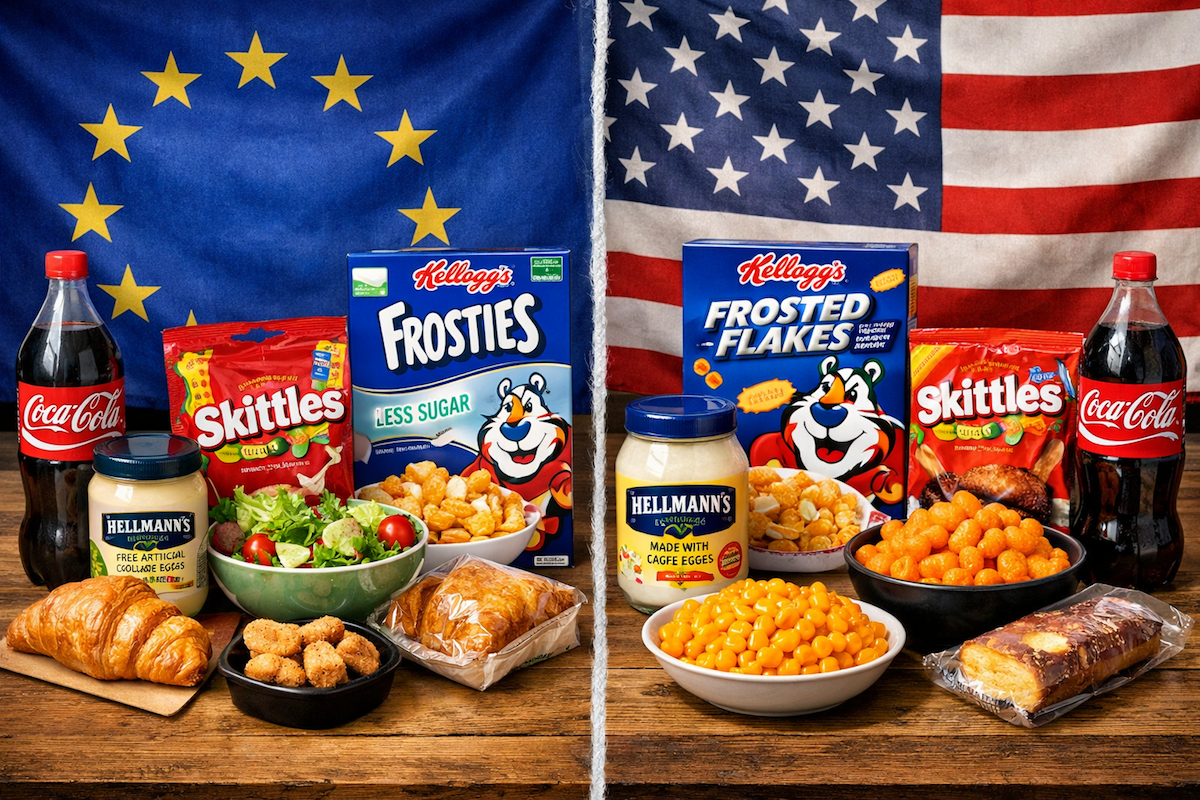
Same Brands, Same Products, Worse Ingredients and Why Americans Should Be Pissed Off
Here’s the part they really don’t want Americans thinking too long and hard about…
After a short ferry ride from Saranda to Corfu, I wandered into a supermarket and spotted the usual suspects.
There I was staring at the same brands I’d grown up with back in the States. All with familiar logos and the usual polished nonsense on the packaging, trying to convince people this stuff was actually wholesome and “healthy”.
Then I flipped a few of the packages over.
The ingredient lists were cleaner than the versions sold back home.
One brand, two standards.
That’s when this stops being a food story and starts feeling like a slap in the face.
These companies already know how to make their products with fewer questionable dyes and other dodgy ingredients.
They do it for Europe all the time. They just seem to forget how, the minute the customer is… well, you guessed it, American.
So why do they make safer food for Europe but not for you in the good ol’US of A?
That’s where things get a little ugly, because the answer has a lot less to do with science and a lot more to do with what they think they can get away with.
1. The Snack Food That Somehow Gets More Innocent in Europe
I first noticed this in Corfu with a bag of chips I’d eaten a hundred times back in the U.S.
It looked like the same bag I knew from home, right down to the flavor and the usual little sales pitch splashed across the front.
Flip it over in Greece and the ingredient list suddenly reads like actual food. No mystery oils. No chemical names that sound like they were invented in a crumbling lab in the Soviet Union.
Flip the American version and it’s a different story.
This isn’t a potato problem. Greece didn’t suddenly crack the code on snack food. The company already knows how to make a cleaner version.
It just stops bothering when the customer is American.
Why It Should Piss You Off: If a company can clean up a product for one market, then your version isn’t about what’s possible. It’s about what they think you’ll tolerate.
2. The Soda That Changes Its Personality Once It Leaves The U.S.
A former teaching colleague of mine from Kyiv had the same moment with soda.
He grabbed a bottle in Europe expecting the usual taste from back home, because nothing about it looked any different at first. Then he checked the ingredients.
The European version used real sugar. The American one leaned on high fructose corn syrup, with a little help from the “Big Corn Lobby” and its friends in Washington. Most people never compare labels across borders.
That’s the trick. The branding says same product. Your brain assumes the rest.
Put the labels side by side and it starts to feel like you’ve been sold two different realities in the same bottle.
Once you spot it, you start seeing it everywhere.
Why It Should Piss You Off: Familiar packaging means nothing. The label tells the truth. The marketing just smiles and hopes you won’t read it.
3. Fast Food That Magically Improves Under European Rules
Fast food is where this gets almost insulting.
I’ve walked into familiar chains in France expecting the same thing I grew up with in America. Same menu boards. Same color schemes.
The same plastic corporate charm with the fake “Have a nice day” vibes.
The difference is buried in the ingredients.
Bread recipes change, and Europe often skips certain preservatives, artificial dyes, bromated flour, and some of the oils that still show up in American fast food.
Here’s the funny part. These companies don’t go broke when they clean things up abroad. They keep the same packaging, comply with EU standards, and still keep printing money.
So that excuse about change being too hard or too expensive falls apart pretty quickly.
They’ve already shown they can do it.
They just do it when someone makes them.
Why It Should Piss You Off: Whenever someone says safer ingredients are unrealistic, remember this. These same companies already do it elsewhere and still make a fortune.
If this kind of thing keeps making you rethink what passes for normal in the U.S.A, To Expat or Not To Expat is the best place to start.
It helps you figure out what still fits and what your real options actually are.
4. The Candy That Gets Cleaner When the Kids Aren’t American
This one lands harder if you’ve ever watched kids go nuts in a candy aisle.
All that color and cartoonish packaging makes the whole thing look harmless, even when it’s basically sugar-fueled chaos in plastic wrapping.
In parts of Europe, some of those same candies use different coloring or come with warnings that would make a parent stop and squint.
In the United States, those same products often show up without that extra warning labels.
So yes, companies can change the formula when rules or pressure demand it.
That raises a pretty ugly question.
If they’re willing to change it for one group of kids, why not all of them?
Why It Should Piss You Off: When companies clean up child-focused products for one market but not another, they’re telling you exactly where caution matters and where it apparently doesn’t.
5. The Bread That Lasts “A Little Too Long” in the U.S.
Bread should be simple.
Flour. Water. Yeast. Salt.
Spend time in France or Georgia, where they literally bake bread in giant wood fired clay pots on every other corner, and you notice bread behaves differently.
It goes stale faster. Which is actually reassuring. It tastes like real food, not some high school chemistry experiment with a best-before date.
Back in the U.S., bread can sit on your counter like it’s got a pension plan (remember those).
That kind of shelf life comes with baggage.
Preservatives. Additives. Some even have food coloring, if you can believe that! Ingredients that stretch time while also stretching the definition of bread.
Companies already know how to make it without all that extra nonsense. But, they do it in markets where people expect better.
Why It Should Piss You Off: If your bread could survive a minor apocalypse, it might be worth asking what had to be done to make that happen.
6. The Processed Snacks That Quietly Lose Ingredients Overseas
By this point, it stops looking random.
Different oils. Fewer additives. Small tweaks that add up to a noticeably different product.
I’ve seen this pattern in Greece, France, and elsewhere in Europe. The changes aren’t always dramatic. Sometimes it’s just one or two ingredients missing.
That’s exactly what makes it worse.
The fixes are often small. Easy and totally doable.
At some point this stops looking like a few odd examples and starts looking like a business model.
Why It Should Piss You Off: When multiple brands keep making the same changes abroad, that’s not a coincidence. That’s a strategy.
7. The Frozen Meals That Get Less Weird Outside the U.S.
Frozen meals are supposed to be about convenience.
Quick and easy. Low effort. A break for people who can’t be bothered to cook.
In Europe, that convenience often comes with cleaner ingredient lists. Not perfect, but better.
In the United States, convenience too often arrives dragging a long list of additives behind it like a bad ex who won’t move out.
Convenience isn’t the problem.
The problem is how far companies are willing to push it depending on the market.
Why It Should Piss You Off: Convenience doesn’t have to mean lower standards. These companies prove that every day outside the United States.
8. Breakfast Foods That Look Identical But Are Anything But
This one might be the sneakiest of them all.
You walk into a store and see the same cereal boxes you grew up with. Same colors. Same trademark cartoon characters. Same promises of nutrition, energy, health, well-being and whatever other nonsense a cartoon animal is selling this week.
The design barely changes, but what’s inside often does. Europe gets the cleaner formula, while Americans get more junk hiding behind the same cartoon grin that looks innocent but acts guilty.
The packaging builds trust.
The ingredients quietly wreck it.
Most people never think to compare labels across borders, and companies are counting on that.
Why It Should Piss You Off: If the front of the box says one thing and the ingredient list says another, believe the ingredient list. The mascot is not your lawyer.
9. The Real Reason They Don’t Change U.S. Formulas
By now, the pattern’s hard to ignore.
These companies and their CEOs don’t suddenly grow a conscience.
They change formulas when regulators, lawsuits, or public outrage start breathing down their necks and hurting their bottom line.
In the United States, those pressures are often weaker.
That leaves room.
Inside that room, profit margins get very comfortable.
When lobbyists have influence and regulators take forever to act, people fill in the gaps by assuming the food must already be safe enough. That’s exactly how companies get away with this.
Different standards for different markets.
This isn’t about whether they can do better.
It’s about whether they have to.
Why It Should Piss You Off: When the rules are loose, companies don’t usually reward your trust. They test how much of it they can burn through.
They Already Make It Safer So Why Are Americans Getting A Raw Deal
This stopped being just about food a while ago.
It’s about how American consumers are valued. Or more accurately, how often they’re not.
The fact that these companies sell a cleaner version abroad and a worse version back home tells you this isn’t about ignorance. It’s their business model.
So the real question isn’t just what’s in your food. It’s why Americans are the ones getting the raw deal.
So what do you think this really comes down to. Regulation, profit, or a little of both?
If this article hit a nerve because it feels bigger than food, To Expat or Not To Expat is the best place to start. It’ll help you figure out whether you need to rethink life in the U.S., test life abroad more carefully, or move toward something more permanent without doing anything reckless.

David Peluchette is a Premium Ghostwriter/Travel and Tech Enthusiast. When David isn’t writing he enjoys traveling, learning new languages, fitness, hiking and going on long walks (did the 550 mile Camino de Santiago, not once but twice!), cooking, eating, reading and building niche websites with WordPress.