
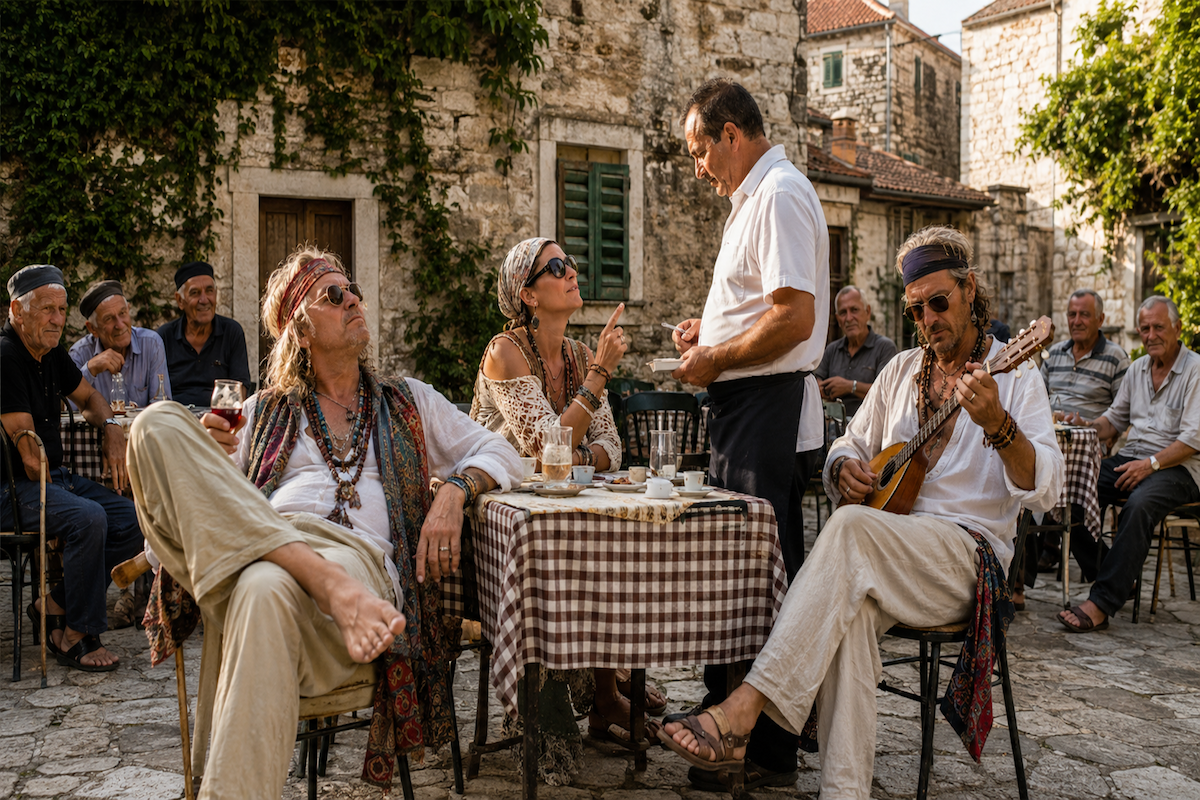
Some People Don’t Move Abroad To Explore A Culture. They Move Abroad To Escape Themselves.
I once met an American expat in Tbilisi who had been abroad for exactly eleven days and already spoke about the United States like it was a collapsing Roman Empire fueled entirely by ranch dressing and mass shootings.
Every sentence started with, “Well, unlike Americans…” even though he was from Ohio and still pronounced “khachapuri” like a medical condition.
By the second beer, he was aggressively correcting other foreigners on Georgian history, lecturing locals about their own politics, and insisting he now “felt more Eastern European spiritually.” Whatever that means.
Then came the final boss level of expat cringe.
He started mocking newly arrived Americans for asking innocent questions about local customs, rolling his eyes like some grizzled cultural veteran who’d crossed the Silk Road barefoot instead of arriving on a budget Wizz Air flight two Tuesdays earlier.
I’ve seen versions of this guy everywhere from Kyiv to Greece to even little expat corners of Albania.
At first, it looks like cultural adaptation.
Then you realize some people aren’t adapting abroad.
They’re disappearing into it.
📌Backroom Note: The Substack version of this article includes a private Expat Backroom section at the end. The public article below is complete, but paid Backroom members can read the more candid version behind the story on Substack.
1. The Instant Anti American
I met an American in Tbilisi who’d been abroad for maybe ten days and already talked about the United States like he was testifying before the Hague.
Every conversation became a performance.
“Americans are so fake.”
“Americans don’t understand real culture.”
“Europeans are just more evolved.”
“The U.S. is going to hell in a handbasket.”
Meanwhile, the guy still couldn’t pronounce khinkali correctly and nearly fainted trying Georgian chacha for the first time.
What always got to me about these expats wasn’t the criticism itself. Living abroad absolutely changed how I see the U.S. too.
Spend enough years in Ukraine, France, Greece, or Albania and you’ll start noticing things you never questioned before.
But there’s a difference between perspective and self erasure.
Some expats reject their own culture so aggressively because they think shame equals sophistication.
Gone Native: Rejecting your home culture too quickly usually says more about insecurity than cultural intelligence.
2. The “I’m Not Like Other Expats” Expat
This expat needs you to know they’re different.
Not like those loud tourists in cargo shorts asking for ranch dressing in Europe.
No no.
They’re cultured now.
I met a guy in Kyiv who proudly announced he “only hangs out with locals” while sitting at a table full of foreigners speaking English.
The irony died instantly.
These people spend more energy distancing themselves from other expats than actually learning the culture around them.
Every conversation becomes a branding exercise designed to prove they’re one of the “good foreigners.”
Honestly, it starts feeling less like confidence and more like social insecurity in artisan coffee shop form.
Gone Native: The louder someone proves they belong, the less secure they usually are.
3. The Local Approval Addict
I knew an expat in Kyiv who changed personalities depending on who entered the room.
With Americans he mocked Europe.
With Europeans he mocked the U.S..
With locals he suddenly became a passionate expert on Ukrainian politics despite barely understanding half the conversations happening around him.
Watching it happen in real time felt weird.
Like seeing someone constantly refreshing their personality settings.
Living abroad can make approval feel addictive because everything else already feels unstable.
- New language.
- New customs.
- New mentality.
- New social rules.
Your brain desperately wants reassurance that you belong somewhere.
That’s when some people slowly stop expressing opinions and start mirroring environments.
Gone Native: Once approval abroad feels necessary, independent judgment starts slipping.
4. The Overnight Political Convert
I once watched an American guy in France become a full blown anti capitalist revolutionary after dating a French girl for two months.
Two months.
Before that he worked in corporate finance and owned three watches that probably cost more than my apartment in Kyiv back in 1999.
Suddenly he was lecturing everyone about the collapse of Western civilization over wine he couldn’t pronounce.
Living abroad absolutely broadens your political worldview. Mine changed too after years in post Soviet Ukraine and elsewhere.
But some expats don’t thoughtfully evolve.
They socially shapeshift.
Politics becomes less about understanding and more about camouflage.
Gone Native: Borrowed beliefs often become social camouflage.
5. The Relationship Chameleon
This one honestly gets sad.
I watched a guy in Ukraine completely reconstruct his personality around his local girlfriend because she became his emotional anchor abroad.
At first it looked harmless.
The clothes changed first. He picked up smoking. Then the drinks. Beer gave way to vodka, cognac, and lemon, until even his opinions started sounding imported. After a while he became almost unrecognizable.
I swear, after a few drinks he’d start speaking English with a Russian accent.
He was from New Jersey.
Living abroad can make relationships feel emotionally amplified because everything outside the relationship feels uncertain.
Some people don’t just fall in love abroad.
They emotionally morph into another person.
Gone Native: Some people don’t fall in love abroad. They attach themselves to whoever makes the unfamiliar world feel survivable.
6. The Fake Cultural Expert
Nothing creates false confidence faster than six months abroad.
I met an expat in Tbilisi who corrected locals on Georgian history after spending one summer drinking wine, posting black and white café photos online, and learning three phrases in Georgian.
Painful.
Another guy in France constantly mocked new arrivals for making “rookie tourist mistakes” while still pronouncing basic French words like he was reading IKEA furniture instructions aloud.
The longer I’ve lived abroad, the less convinced I’ve become that I fully understand anywhere.
That humility matters.
Because foreigners who think they’ve completely cracked the cultural code usually become the easiest people to manipulate.
Gone Native: The easiest expats to exploit are often the ones convinced they’ve stopped being foreigners.
7. The Expat Who Started Hating Tourists
I caught myself drifting toward this mentality once in Saranda.
A loud tourist near the beach started complaining that Albania wasn’t “modern enough,” and my immediate reaction was pure irrational territorial rage.
For a second I wanted to defend Albania like I personally owned the Balkans.
That’s when I realized something horrifying.
I was slowly becoming one of those bitter long term expats who acts like newcomers are contaminating “their” country.
You see this constantly abroad. Expats who mock tourists even though they originally arrived the exact same way.
Sometimes even worse.
Gone Native: Sometimes “experience” abroad is just insecurity with seniority.
8. The One Who Couldn’t Relate To Home Anymore
This one sneaks up slowly.
After enough years abroad, going back home can feel strangely disorienting.
I remember visiting the U.S. after years living in Ukraine and France and feeling weirdly detached during ordinary conversations.
People talked about chain restaurants, celebrity gossip, office politics, and the latest flavored coffee trends while my brain quietly drifted somewhere else entirely.
Nothing felt wrong exactly.
It just no longer felt fully mine.
That’s the hidden loneliness many long term expats never talk about. You adapt so deeply to life abroad that eventually your original environment starts feeling emotionally foreign too.
Gone Native: Some expats adapt so hard to everywhere else that they stop feeling grounded anywhere.
9. The One Who Became Emotionally Untethered
This was the expat type that honestly scared me most.
Not the loud tourists.
Not the clueless newcomers.
The emotionally untethered ones.
The people who reinvented themselves so many times across so many countries that eventually there didn’t seem to be a stable core left underneath anymore.
Years ago, I met a traveler bouncing around Europe who never seemed to arrive anywhere as himself.
Give him a few months in a new country, and he’d come back talking differently, even changing his accent, chasing some new obsession or philosophy, convinced he’d finally figured life out this time.
At first he looked adaptable.
Then his whole persona started to feel a bit unnerving.
Maybe it’s because, if I’m being truly honest here, I’ve seen myself doing some of the same things at one time or another, over the years.
Living abroad naturally changes you. I know it’s changed me.
But some people slowly become whatever version of themselves gets rewarded most in each environment until eventually they stop knowing which version is real.
Gone Native: Some people don’t lose themselves abroad all at once. It happens slowly through years of becoming whoever the environment rewards.
The Expats Who Scared Me Most Weren’t The Clueless Ones
The clueless expats never worried me that much.
At least they still knew who they were.
The ones that stayed with me were the people who slowly dissolved into every country they entered until there was barely anything stable left underneath.
That’s the hidden psychological cost of living abroad nobody really talks about.
One day you realize your old routines are gone, your native language feels rusty, and the confidence you arrived with got beaten out of you somewhere along the way.
Sometimes you can even lose the ability to separate genuine personal growth from survival based adaptation.
Honestly, I expanded this idea much deeper inside The Expat Backroom because these patterns aren’t random.
After years living across Ukraine, France, Georgia, Greece, and Albania, I’ve watched this happen again and again, and to a certain extent, I’ve even seen it happen to myself.
Most people don’t notice it until much later.
So now I’m curious.
Have you ever met an expat who seemed just a little too desperate to “go native”?
Or worse.
Have you ever caught yourself slowly “going native” too?
Living abroad, or seriously thinking about it? Do you have a Plan B?
Expats Planet helps expats and future expats know what can go wrong, how to avoid it, and what to do if things go sideways anyway.
Start here: ExpatsPlanet.com
The Expat Backroom
I’ve added a private Expat Backroom section to the Substack version of this piece.
The public article here is complete, but the Backroom is where I add the more candid version behind selected stories: what I left out, what I think really happened, and the sharper life-abroad lesson underneath it.
Read about The Expat Backroom here.


David Peluchette is a Premium Ghostwriter/Travel and Tech Enthusiast. When David isn’t writing he enjoys traveling, learning new languages, fitness, hiking and going on long walks (did the 550 mile Camino de Santiago, not once but twice!), cooking, eating, reading and building niche websites with WordPress.