
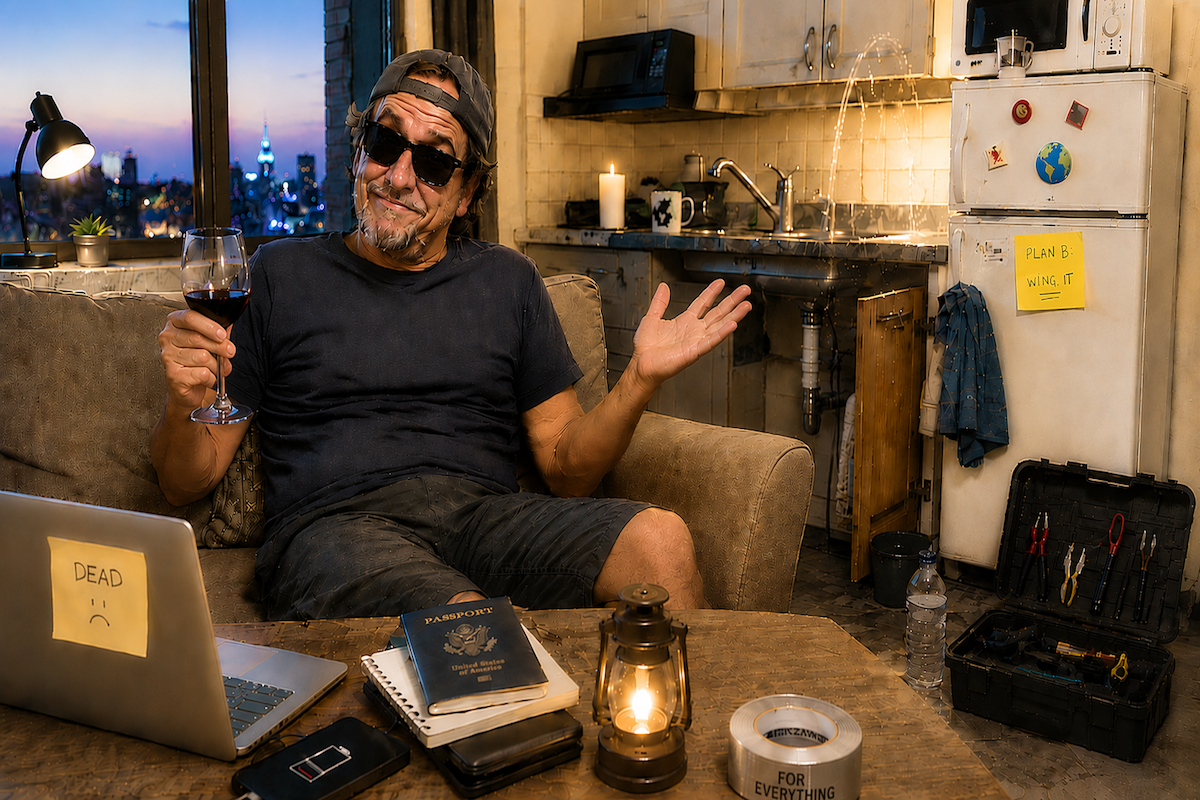
Nobody Warns You That The More Independent You Become Abroad, The Less Room You Have For Things To Go Wrong.
Have you ever noticed that the more independent you become abroad, the less room life gives you to fall apart?
When I first moved abroad, solving problems on my own felt like a badge of honor.
I survived bureaucratic hellscapes in Ukraine. I learned to expect that something in every apartment would eventually stop working. I also learned that one delayed flight could unravel an entire travel plan.
Every problem I solved convinced me I was becoming more independent.
I thought I’d finally cracked the code.
Then one day I realized I’d quietly built a life where everything depended on one person showing up every single day at one hundred percent.
Me.
- A dead laptop.
- A nasty flu.
- A frozen bank card.
- An unreachable landlord.
- A broken water heater.
None of those things are disasters on their own. But stack a few of them together and suddenly freedom starts feeling suspiciously like a full time job.
If you’re dreaming about moving abroad, or you’ve already built a life overseas, these are the six hidden truths I wish someone had told me before I confused total independence with real freedom.
1. My Entire Life Was Inside One Laptop
A few weeks after moving into a little basement apartment in Tbilisi, my Mid-2010 MacBook Pro died.
Not slowed down.
Died.
At first I wasn’t too worried. I’d already replaced the fan myself years earlier in Kyiv after one repair shop quoted me nearly half the value of the laptop just to fix it. Thank God for YouTube and a cheap magnetic laptop screwdriver kit.
This time felt different.
I pulled the laptop apart, figured out the memory drive had failed, then spent the better part of a day wandering around my local Saburtalo district carrying that tiny piece of hardware in my pocket.
- Office supply stores.
- Phone shops.
- Computer repair places.
Explaining what I needed, first in English, then in Russian. My Georgian was still limited to Good Day (Gamarjoba) and Thank You (Madloba).
Eventually someone pointed me toward a tiny electronics repair shop halfway up a hill that I never would’ve found on my own. The guy behind the counter spoke Russian, took one look at the drive, disappeared into the back, and somehow came back carrying exactly the replacement I needed.
Thirty bucks later, I was back in my apartment installing it myself.
I laughed about it afterward.
Then I realized my work, my files, my income, and a good chunk of my life had all been riding on a nine year old laptop in a country where I didn’t even know if Apple officially existed.
That wasn’t independence.
That was one very expensive single point of failure.
Even Freedom Needs A Backup Plan: I built a life that looked fiercely independent, although one dead laptop nearly brought all of it to a standstill.
2. Being Sick Didn’t Cancel Anything
I remember lying in bed in Kyiv with one of those flus where even getting up to make tea felt like climbing a mountain.
All I wanted to do was stay under the blanket. Instead, I had to drag myself out the door, somehow piece together enough Russian through my flu induced delirium to get what I needed, and figure it out myself.
I was on my own.
That’s when I noticed something I’d never appreciated back in the States.
Healthcare wasn’t really the issue. The real luxury was having someone who could simply take something off your plate when you weren’t capable of carrying it yourself.
Even Freedom Needs A Backup Plan: A good pharmacy matters. So does having somebody who can help you reach it when you’re in no condition to become your own caretaker.
3. Every Repair Became My Emergency
One apartment I rented in Kyiv looked perfect.
Until something broke.
The internet stopped working just before an online meeting. Another time the hot water disappeared without warning. The landlord confidently promised he’d come “tomorrow,” which, as many of us who’ve lived abroad eventually learn, can be one of the most flexible words in the dictionary.
After enough apartments in Ukraine, Georgia and Albania, I stopped judging flats by the photos.
I started judging them by what would happen if something went wrong.
That turned out to be a much better way of measuring whether a place was actually livable.
Even Freedom Needs A Backup Plan: I stopped judging a home only by how comfortable it felt when everything worked.
4. Bureaucracy Always Wanted Me At Full Strength
I’ve lost count of how many afternoons disappeared inside a bank, a cell phone provider, or some online government portal that suddenly decided I no longer existed.
Usually, I solved it. My Russian was good enough. My patience usually held out. Eventually somebody found the missing document or clicked the right button.
I almost always found a solution. I just didn’t like how much of my day disappeared every time life threw one of these little curveballs at me.
Back home, most of these things would’ve been a minor annoyance. Abroad, they could consume half a day and whatever patience I had left.
Even Freedom Needs A Backup Plan: I could usually solve the problem. But, I began questioning how often I wanted my ordinary life to require that much solving.
5. Travel Freedom Came With Contingency Plans
One of the things I love most about living in Saranda is how easy it is to wake up and think, “Maybe I’ll spend the day in Corfu.”
That’s the dream everybody sees.
What they don’t see is that every spontaneous trip starts with a quiet little mental checklist.
- Ferry.
- Weather.
- Passport.
- Return crossing.
- Worst case scenario.
- Could I handle an unexpected night in Greece?
Ironically, the easier travel became, the more preparation disappeared into the background.
Even Freedom Needs A Backup Plan: The freedom to leave whenever I wanted felt different once I understood how much planning was required to return without any issues.
6. I Got Tired Of Always Having A Plan B
None of these things ever made me want to leave.
What wore me down was realizing my brain never completely switched off.
I always knew where my passport was. I kept digital copies backed up and made sure I knew how to contact the nearest U.S. Embassy if the original ever disappeared.
I always had emergency cash tucked away, hoping I’d never need it.
I kept an eye on the expiration dates for my bank cards, credit cards and U.S. driver’s license because those weren’t things I wanted to discover the hard way.
Important documents lived in three different places.
Every trip had a Plan B somewhere in the back of my mind because I’d eventually learned life abroad has a habit of asking awkward questions at the most inconvenient moments.
Looking back, I don’t think I was preparing for disasters.
I was preparing for ordinary Tuesdays.
Even Freedom Needs A Backup Plan: Independence stopped feeling like freedom whenever my entire life depended on me always having a plan B.
I Finally Realized What Independence Was Supposed To Look Like
I still wouldn’t trade this life for anything.
Ukraine taught me resilience. France taught me to slow down. Georgia reminded me that not every clock deserves to be obeyed. Albania reminds me every morning why I chose this life in the first place.
What changed wasn’t the dream.
It was my definition of independence.
For years, I thought being independent meant being able to solve every problem by myself. These days, I think it means building a life that can survive the occasional week when I can’t.
Because sooner or later, all of us have one of those weeks.
If you’re already living abroad, or you’re planning to, ask yourself one question.
If everything went sideways next Tuesday, what would you do?
What’s your “Plan B”?
I’d love to hear your answer in the comments.
Before You Pack Another Suitcase… Ask Yourself This
One difficult week doesn’t tell you whether life abroad is right for you.
Sometimes it tells you whether the life you’ve built abroad is.
That’s exactly why I wrote Is Life Abroad Really For Me?
It isn’t another book about visas, budgets or picking the “perfect” country. It’s about asking yourself the questions most people don’t think about until they’re already unpacking their boxes overseas.
The article ends here. Thanks for reading!
The Expat Backroom begins here in the Substack version. That’s where I answer the harder question. What backup plans would I build first if I were moving abroad all over again?


David Peluchette is a Premium Ghostwriter/Travel and Tech Enthusiast. When David isn’t writing he enjoys traveling, learning new languages, fitness, hiking and going on long walks (did the 550 mile Camino de Santiago, not once but twice!), cooking, eating, reading and building niche websites with WordPress.