
What Feels Friendly in the U.S. Can Quietly Scream “Sucker!” Overseas
I used to think awkward questions abroad only made people uncomfortable. Then I realized they could also make you look like easy prey.
I learned that the hard way years ago in Kyiv.
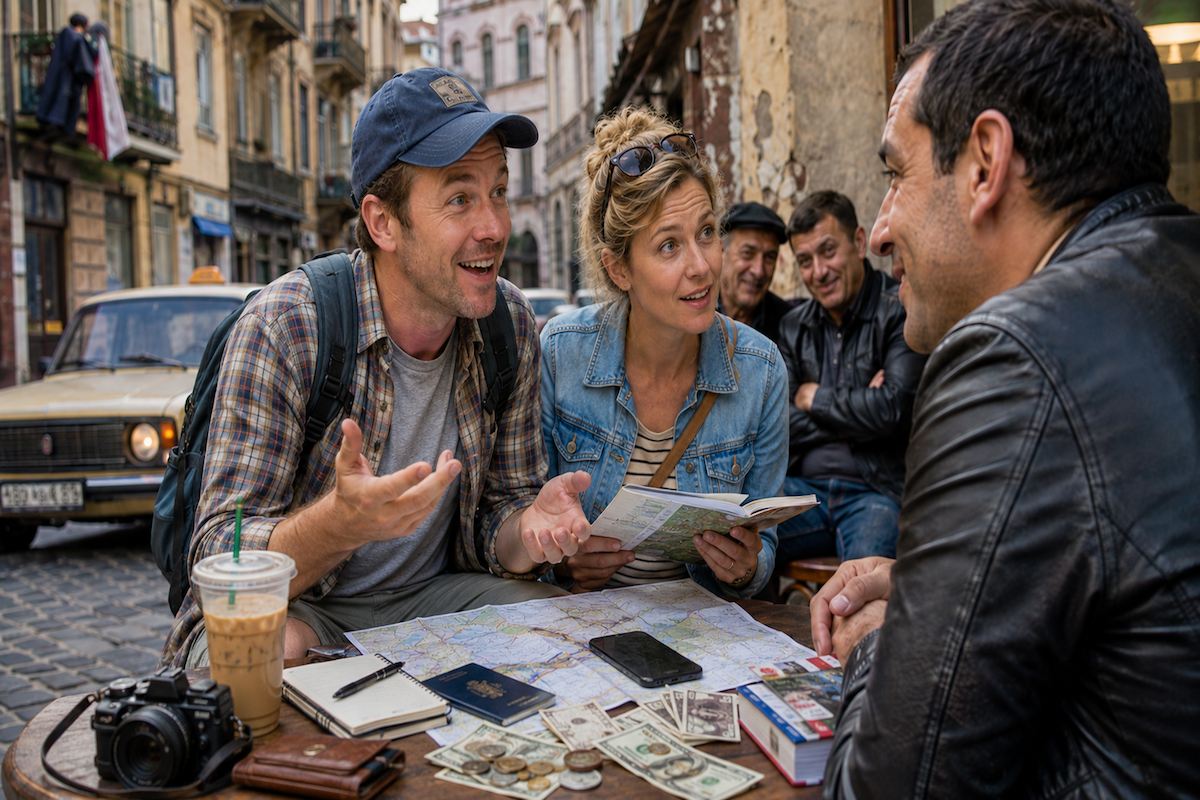
I was sitting in a small café asking what I thought were perfectly normal American questions.
- How much should a taxi cost?
- Which neighborhoods were “good”?
- Was this area safe?
- Where’s the closest ATM?
The guy across from me suddenly became a little too friendly.
By the end of the conversation, I somehow had a “trusted driver,” an apartment lead, and a phone number for his cousin who could “handle paperwork problems.”
Funny how quickly that happened.
At first, I thought people were fascinated by the clueless American asking questions like a first grader that had just discovered Europe.
Then the prices started changing.
The tone changed too. People stopped talking to me like someone who clearly didn’t understand how things worked yet.
That’s when it hit me.
That’s when I realized the problem wasn’t sounding like an American.
It was sounding like the guy who still thought the menu price, taxi price, and foreigner price were all the same thing.
The questions are harmless.
The message underneath them isn’t.
1. “So… What’s a Normal Price Around Here?”
I made this mistake constantly when I first moved to Kyiv. Taxi drivers, outdoor markets, apartment listings, I was basically walking around announcing I had no idea what anything should cost.
One taxi driver near the train station smiled the second I asked him what a “normal” fare was.
That smile should’ve warned me.
The ride took fifteen minutes. The price he gave me sounded like he was trying to finance his grandchildren’s future in one afternoon.
Back then, I thought I was just dealing with “foreigner pricing.”
Later, I realized I was signaling something bigger.
Uncertainty.
People start recalculating how to deal with you the second they realize you don’t understand local value systems.
Suddenly everybody becomes helpful. Helpful apartment guy. Helpful taxi guy.
Funny how expensive “help” can get abroad.
Don’t Get Played: The moment people realize you don’t understand how much things cost locally yet, is the moment you’ve lost your leverage.
2. “Can You Recommend a Good Neighborhood?”
When I first arrived in Tbilisi, everybody had advice.
One expat swore I needed to live in Vake because “that’s where the serious foreigners stay.” Another guy insisted Saburtalo was better because it was “more authentic.” A local Airbnb host tried convincing me that a crumbling apartment with Soviet plumbing was a “hidden gem.”
Apparently every overpriced apartment abroad is a “hidden gem.”
At first, all this advice felt comforting. Moving abroad overloads your brain fast. New people. New language. New systems. Confusing bureaucracy.
That’s where things get slippery.
Sometimes the first person helping you abroad isn’t helping because they know better. They’re helping because they immediately recognize an opportunity.
I’ve noticed this pattern everywhere from Ukraine to Albania. New arrivals often confuse confidence with competence.
Then six months later you’re stuck in an overpriced apartment wondering how this became your life.
Don’t Get Played: The faster you need certainty abroad, the easier it becomes for someone else to shape your decisions.
Most people think the biggest expat mistakes happen during emergencies.
They usually start much smaller than that.
A bad apartment recommendation. The wrong “helpful” person.
I break these patterns down much deeper inside The Expat Autopsy ($47), because small misunderstandings overseas have a way of quietly turning into bigger and more expensive problems later.
3. “Is This Area Safe?”
I once asked somebody in Kyiv if a neighborhood was safe at night.
He shrugged and said, “Yeah, no problem.”
A few hours later I watched two drunk guys fighting near a kiosk while another man casually relieved himself against a building like this was perfectly normal human behavior.
That’s when I realized something important.
We weren’t using the word “safe” the same way.
A local might define safe as “you probably won’t get stabbed.”
Meanwhile, your American brain may define safe as “I’d feel comfortable walking around here while checking Google Maps with my AirPods in.”
Huge difference.
I’ve run into this in Georgia too. Somebody tells you an apartment area is “quiet,” then you discover the neighborhood dogs conduct nightly psychological warfare from 2 AM until sunrise.
Don’t Get Played: Abroad, people can answer your question honestly while still leaving you dangerously uninformed.
4. “Can I Trust This Person?”
One of the strangest things about living abroad is how quickly relationships accelerate.
Back home, trust builds slowly. Abroad, loneliness hits the gas pedal. Somebody speaks your language, helps you open a bank account, translates a phone call, invites you to dinner once, suddenly your brain starts treating them like a lifelong ally.
That can get weird fast.
I’ve met great people abroad. Some of the kindest people I’ve ever known were in Ukraine, France, Albania, and North Macedonia. Still, living overseas taught me that convenience and loyalty aren’t the same thing.
A guy once helped me navigate paperwork problems in Kyiv for weeks. Super friendly. Always available. Then the second things became complicated, he vanished like a magician escaping a locked water tank.
No fight. No explanation. Just gone.
At first I took it personally. Later I understood something uncomfortable. Many expat relationships are built on temporary usefulness.
Don’t Get Played: Loneliness abroad can make almost anyone seem trustworthy faster than they should.
5. “Why Is Everyone Being So Nice to Me?”
When I first moved abroad, I loved how approachable people seemed.
In France, random conversations stretched into hours. In Albania, café owners remembered my coffee order after two visits. In Ukraine, I’d sometimes get invited to family dinners after knowing somebody for about twelve minutes.
As an American, that feels amazing at first.
Then you stay overseas long enough to notice something else. Friendliness abroad sometimes comes with invisible strings attached. Favors create obligations. Hospitality creates expectations.
Nobody explains this part to new expats.
One guy I met in Tbilisi seemed unbelievably generous. Rides across town. Introductions. Invitations everywhere. Eventually every favor circled back to something he wanted in return.
Don’t Get Played: Feeling welcomed abroad can sometimes lower your guard faster than you realize.
6. “Why Does Everything Feel So Complicated?”
Nothing humbles you abroad faster than bureaucracy.
You can survive culture shock, weird food, language barriers, and mystery meat pizza in Ukraine covered in mayonnaise. Then one residency office destroys your confidence in under four minutes.
I remember sitting in a government office in Kyiv clutching a folder full of translated documents like they were sacred ancient scrolls.
Didn’t matter.
The woman behind the counter looked at my paperwork for about ten seconds before casually informing me that the rules had changed.
That sentence hits differently overseas.
Back home, Americans are trained to believe systems are procedural. Abroad, you eventually discover some systems function more through interpretation, relationships, timing, and leverage than strict logic.
Don’t Get Played: The biggest mistakes abroad usually happen when people assume the system works like the one they left behind.
7. “Wait… Was I the Problem the Entire Time?”
This was probably the hardest realization of all.
For years, I kept thinking certain frustrations abroad were about other people.
- Why are they so indirect?
- Why is everything so inefficient?
- Why does nobody explain anything clearly?
- How do people live like this?
Then eventually a pattern started staring back at me.
The countries kept changing.
The confusion didn’t.
Ukraine. France. Georgia. Albania. Different languages. Different systems. Yet somehow I kept carrying the same assumptions into every environment like overweight emotional luggage.
That’s when living abroad stopped being just cultural.
It became psychological.
You start realizing how many invisible American defaults you carry around without questioning them. Ideas about customer service. Communication. Efficiency. Personal space. Safety. Friendliness. Fairness.
Don’t Get Played: The hardest part of living abroad usually isn’t learning a new culture. It’s realizing how much of your old one you never questioned.
The Real Reason Americans Get Blindsided Overseas
The awkward moments usually aren’t the real problem.
They’re symptoms.
Tiny leaks that reveal how little you actually understand about the systems, incentives, and people around you.
Most expats think they’re learning about another country. Sometimes they’re really learning how visible their own blind spots have always been.
That’s the part relocation influencers rarely talk about.
The problem usually isn’t one catastrophic mistake.
It’s dozens of small misunderstandings slowly stacking on top of each other until your confidence or stability starts cracking under the pressure.
Living abroad can absolutely be incredible. Some of the best years of my life have happened overseas.
Still, the fantasy version of life abroad usually leaves out the psychological side of it. The realization that your instincts don’t always travel as well as your passport does.
That’s exactly why I wrote The Expat Autopsy.
Not to scare people away from living abroad, but to dissect the hidden social, psychological, and financial patterns that quietly break people once the rose colored glasses come off and the move abroad fantasy ends.
Because by the time most expats figure out how things really work around them, they’re already reacting instead of deciding.
What’s a moment abroad that completely changed the way you see people, culture, or even yourself?
The Expat Autopsy ($47)


David Peluchette is a Premium Ghostwriter/Travel and Tech Enthusiast. When David isn’t writing he enjoys traveling, learning new languages, fitness, hiking and going on long walks (did the 550 mile Camino de Santiago, not once but twice!), cooking, eating, reading and building niche websites with WordPress.